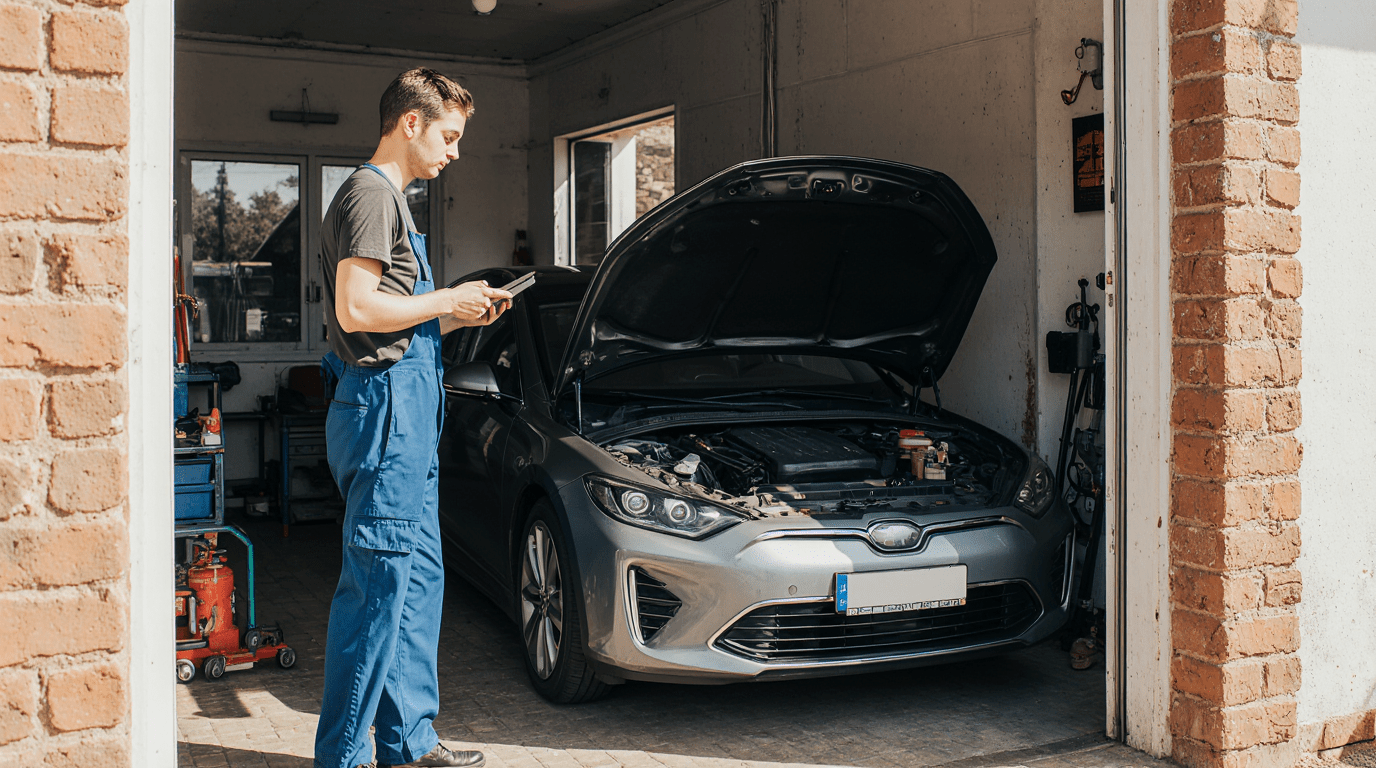
If you live in a small town or village, you've probably already seen an electric car parked next to the pharmacy, the town hall, or the main square. They've gradually become a part of the landscape: quiet, clean, and technologically advanced. But there's a question many drivers start asking themselves when it's time for the first service or an unexpected problem arises: "Where do I take it?"
The shift towards electric mobility is progressing well, but the capacity to repair it isn't keeping pace. And this is where a real challenge arises, one that doesn't just affect the automotive sector: the lack of skilled labor in electromechanics and high-voltage systems . Without trained technicians, small-town workshops risk becoming obsolete.
Today we'll analyze whether, in five years, an independent workshop anywhere in Spain will be able to repair an electric vehicle as easily as they change a clutch or a timing belt today. And, above all, what would have to happen for that answer to be "yes."
Why is there such a shortage of skilled labor?
The problem isn't new, but it has become urgent. The electrification of the vehicle fleet has completely changed the types of breakdowns and the knowledge needed to deal with them. Traditional mechanics have given way to a world dominated by electronics, software, high-voltage batteries, and strict safety protocols.
The factors that explain this lack of trained professionals are clear:
1. Electronics has overtaken mechanics
Many veteran mechanics are experts in internal combustion engines, but not in inverters, power modules, or battery thermal management. It's not a lack of skill; it's simply that the system is completely different.
2. High voltage = real risk
Working with 400V or 800V requires mandatory certifications , specific PPE, and procedures that cannot be improvised. Small workshops often don't even know where to begin.
3. Slow and expensive training
Official courses are lengthy and the equipment for practice isn't cheap. For a rural workshop, making that investment is tough. It's not just the training: it's tools, space, software, and time.
4. Lack of young replacements
Vocational training in the automotive sector is experiencing a shortage of students. Many young people are opting for IT, renewable energy, or other more technological fields. This talent gap is also being felt in the electric vehicle maintenance sector.
5. Constant obsolescence
Electric vehicles are evolving at a rapid pace. A technician trained two years ago already needs to update their knowledge because the platforms, charging systems, and electrical architecture are changing quickly.
The reality of village workshops in Spain
In Spain, a large proportion of independent repair shops are located in medium-sized or rural towns. They are family businesses or small teams that have been repairing combustion engine vehicles for decades. They do impeccable work, but the transition to high voltage is not trivial.
The main obstacles are:
- Specific diagnostic equipment for electricians (each brand usually has its own).
- Cost of specialized training , which does not always guarantee an immediate return.
- Mandatory safety protocols that require reorganizing the workshop.
- Limited access to manufacturers' technical software .
- Lack of space to handle batteries safely.
And something that almost no one mentions:
A mistake in a high-voltage repair is not a breakdown... it's a personal risk.
That's why many workshops prefer to reject electric vehicles. It's not a lack of willingness, it's a matter of responsibility.
This is already happening in many towns
Although there is no comprehensive global data, the actual cases are repeated throughout the country:
- Drivers who have to travel 50 to 100 km for a simple diagnosis.
- Workshops that refuse repairs because they lack high voltage certification.
- Vehicles that remain immobilized for weeks waiting for a slot in official services.
- Brands that only authorize certain work at their own dealerships, usually in urban areas.
This creates an obvious gap:
Electrification is progressing, but it is not reaching all territories in the same way.
Will village workshops be able to repair an electric vehicle in 5 years?
The answer depends on the scenario that unfolds. Currently, there are three possible paths.
Scenario 1: Real reconversion of the sector
In this case, rural workshops are committed to training and equipping themselves.
It would be an orderly transition:
· More specialized dual vocational training options.
· Economic support programs for small workshops.
· Manufacturers providing access to documentation and diagnostics.
· Funded or subsidized high voltage courses.
Here, the answer would be yes:
A small-town workshop could repair an electric vehicle without depending on the big city.
Scenario 2: Total Polarization
If training remains expensive and brands restrict technical access, the opposite will happen.
- Urban and official workshops will monopolize the repair of electric vehicles.
- Rural workshops will survive with combustion engines, basic hybrids, and light maintenance.
- The number of electric vehicles will grow, but not their support in the territory.
In this scenario, the answer would be no:
Electrical repairs would be concentrated in urban areas.
Scenario 3: A new profession is born
There is a trend that is beginning to emerge: specialized "itinerant" technicians, something similar to what happened with solar energy.
It would work like this:
· A highly trained professional attends to several workshops in the area.
· The workshops do the basic work and delegate the complex tasks.
· The technician travels with specific equipment and guarantees safety.
· It would be a hybrid model that would allow workshops to remain active and not lose customers.
What does a workshop need to be “electrical-ready”?
Here's a realistic checklist to help you understand what adapting really entails:
- Official certification in working with high-voltage electric vehicles .
- Specific training in batteries, inverters, converters and refrigeration .
- Isolated area for handling batteries.
- Dielectric tools and mandatory PPE.
- Constant updating of diagnostic software.
- Internal safety procedures for the entire team.
- Document management system for accessing technical guides.
The investment varies depending on the level of specialization, but it's not small. Even so, for many workshops it can become their major competitive advantage in just a few years.
What is currently being done
Although there is still a long way to go, there are some interesting developments:
1. Dual Vocational Training focused on electromobility
Several educational centers have already incorporated electric vehicle and high voltage modules, with practical training in real workshops.
2. Manufacturer programs
Some brands offer courses and certifications to independent workshops. The key is for this to expand and become more accessible.
3. Industry Associations
Organizations such as CETRAA or CONEPA have been demanding fair access to software and training for independent workshops for years.
4. Local initiatives
Autonomous communities and municipalities are starting to offer aid for the modernization of workshops.
It's not enough, but it's a step in the right direction.

The question isn't whether electric cars will reach rural areas. They're already arriving.
The question is: who will repair them when they fail?
Independent repair shops have been the backbone of mobility in Spain for decades. If they aren't supported now, the electric transition could leave them behind. And that doesn't just affect professionals: it affects drivers, families, and the economic life of thousands of municipalities.
If we invest in training and provide the necessary tools, village workshops can become key players in this new phase. If we don't, the gap between urban and rural areas will continue to widen.
The future is still open. And five years, in the world of electric cars, can be an eternity or a mere blink of an eye.