Low Emission Zones (LEZs) are not a futuristic concept or a one-off measure for large cities; they are part of the daily lives of millions of drivers in Spain. The problem is not their existence, but the confusion surrounding them: which cars can enter, when, in which cities, and under what conditions.
This article doesn't repeat legal texts or political promises. It explains what Low Emission Zones (LEZs) are today , how they work in practice , and what real options you have depending on the car you drive .
What are Low Emission Zones and why are they important?
Low Emission Zones (LEZs) are urban areas where access is restricted to the most polluting vehicles in order to reduce emissions and improve air quality.
Its implementation is mandatory in:
- Municipalities with more than 50,000 inhabitants.
- Municipalities with more than 20,000 inhabitants with air quality problems.
Currently, it's not just about "having a Low Emission Zone on paper." Most cities required to have one have it in place , with automated controls and a system of penalties.
A key point:
👉 The law requires the creation of Low Emission Zones (LEZs), but each municipality defines the specific restrictions.
That is why there is no single rule valid for all of Spain.
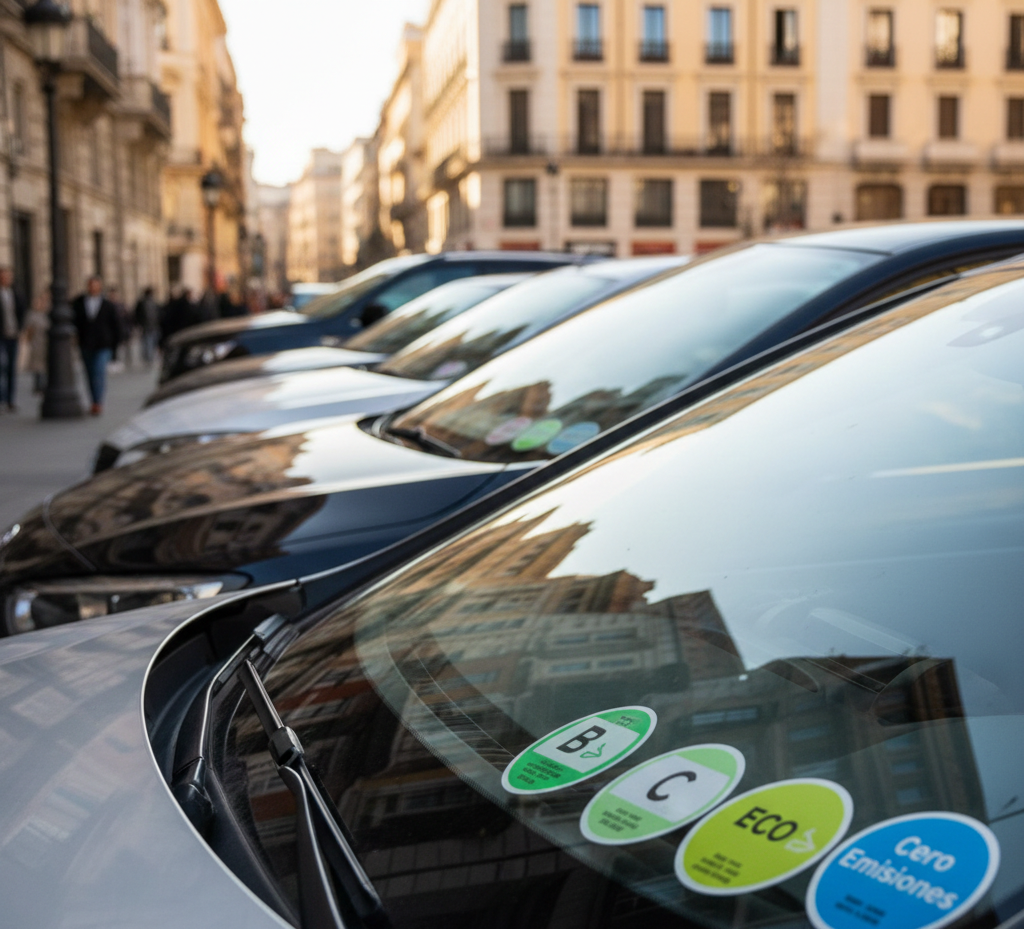
DGT environmental labels : what each one means today
The labels do not guarantee free access. They only indicate the vehicle's emissions level , which each city uses as a reference.
No label.
- Petrol passenger cars prior to 2001.
- Diesel engines prior to 2006.
Current situation.
They are the most restricted, in many cities:
- They cannot access the LEZ.
- They are only allowed in with very specific exceptions (residents, emergencies, historic vehicles).
Label B.
- Gasoline since 2001.
- Diesel since 2006.
Current situation.
It's the most problematic label:
- Limited access.
- In some cities they can only enter at certain times.
- Clear trend towards greater restrictions in the short and medium term.
Label C.
- Gasoline since 2006.
- Diesel since 2014.
Current situation.
- Access is permitted in most ZBEs.
- Specific restrictions during periods of high pollution.
- It is the “minimum” label to move around with relative ease.
ECO label.
- Non-plug-in hybrids.
- Plug-in hybrids with limited electric range.
- Gas-powered vehicles.
Current situation.
- Access is virtually guaranteed.
- Additional benefits in regulated parking and local taxes.
Zero Label.
- Electricians.
- Plug-in hybrids with sufficient electric autonomy.
Current situation.
- Free access to ZBE.
- Clear advantages, although no longer exclusive as they were a few years ago.
What you can do with your car in a Low Emission Zone (LEZ) depending on your actual situation.
This is where most of the doubts arise. Not all commutes are the same.
Living outside the city and commuting to work there
- No label : very limited or prohibited access.
- Label B : depends on the time and the municipality.
- Label C or higher : access permitted in most cases.
Many cities allow occasional access with prior registration, but it is not a stable solution.
Go to a hospital or health center.
- Access is normally permitted for justified medical reasons .
- It may require prior registration or subsequent validation.
- It's not automatic: it's advisable to check local regulations beforehand.
Work, deliveries, or professional visits.
- Some municipalities are considering temporary exceptions.
- Other cities require fleet renewal or vehicle replacement.
- The restrictions particularly affect self-employed people with older cars.
Occasional trips or tourism.
- Entering “just passing through” does not usually exempt you from punishment .
- The cameras do not distinguish whether you are a resident or a tourist.
- In cities with extensive Low Emission Zones, it is advisable to plan parking outside the perimeter.
Fines, controls and how they are applied in practice.
Most Low Emission Zones (LEZs) operate with automated control :
- Cameras that read license plates.
- Cross-referencing data with the DGT (Spanish Directorate General of Traffic).
- Automatic penalty if you do not meet the requirements.
Usual fine.
- Around 200 euros , with a discount for early payment in many cases.
Common mistakes:
- To think that “it was just a moment”.
- Trusting that there are no visible cameras.
- Believing that the label alone guarantees access.
Common exceptions that many drivers are unaware of
Although they vary depending on the municipality, they usually include:
- Residents registered in the ZBE.
- People with reduced mobility.
- Officially recognized historic vehicles.
- Essential services or emergencies.
- Temporary moratoriums in initial phases.
These exceptions are not usually automatic . They typically require prior registration.
What real options do you have if your car starts to have restrictions?
When your car no longer meets regulations, it's not always about changing it immediately.
Adapt habits
- Parking outside the LEZ.
- Use public transport for urban journeys.
- Reduce unnecessary entries.
Changing cars (with good judgment)
- It's not always necessary to go for an electric car.
- A modern gasoline or hybrid engine may be sufficient depending on your usage.
- The label matters, but so does the type of journey.
Renting
- It allows you to adapt to regulations without long-term commitment.
- It includes maintenance and avoids regulatory uncertainty.
- It's not always worth it: it depends on mileage and usage.
Second-hand with better label
- A reasonable alternative for many drivers.
- Key is to review the actual status and the horizon of restrictions.
Frequently Asked Questions about Low Emission Zones in 2026
Does each city apply the Low Emission Zones in the same way?
No. The obligation is state-level, the enforcement is municipal.
Can I get a fine if I just drive through the area?
Yes, if access is not permitted.
Does the label guarantee that I can always enter?
No. It's a reference, not a universal pass.
Can I appeal a fine?
Yes, but only on solid grounds: registration error, poor signage, exception not applied.

In short.
Low-lying areas Emissions regulations are not a blanket ban or a cause for panic. They are a rule of the game , varying from city to city and closely linked to the type of car and how you use it.
The key is not to anticipate with fear, but to understand your situation well , get informed locally and make rational decisions: change habits, plan journeys or consider alternatives when it really makes sense.
With clear information, ZBEs cease to be an abstract problem and become something manageable.