Motorsport has always been a sport of intense passion, but also of high barriers: cost, distance, licensing, and maintenance. In Spain, the combination of professional simulators and esports competitions has begun to break that mold. Today, anyone can race from a simulation center, from home, or as part of a semi-professional team. The phenomenon is no longer a gamer niche; it's an industry that attracts talent, money, and real interest from brands and workshops.
Today, we'll talk a little about what's happening, who's leading the movement, and why simulators are also influencing the world of street cars, from driver training to attracting future workshop customers.
What is an “engine simulation” today
Ten years ago, a home simulator was a basic steering wheel and a video game. Now we're talking about professional platforms with:
- Direct drive steering wheels that replicate the real behavior of a car.
- pedals with load cell sensors.
- curved screens or virtual reality.
- chassis with structural rigidity similar to a real car.
- telemetry comparable to that of a racing team.
The leap has been so significant that several federations and brands are using simulators for training. The result is an experience much closer to driving a real car, but without the associated costs.
Why Spain has become one of the most active countries in the sector
Spain stands out for three reasons:
Deeply ingrained car culture
A passion for Rally, karting, touring cars, Formula 1, and an active community that seeks more accessible ways to experience the world of motorsports.
Simulation centers spread across several cities
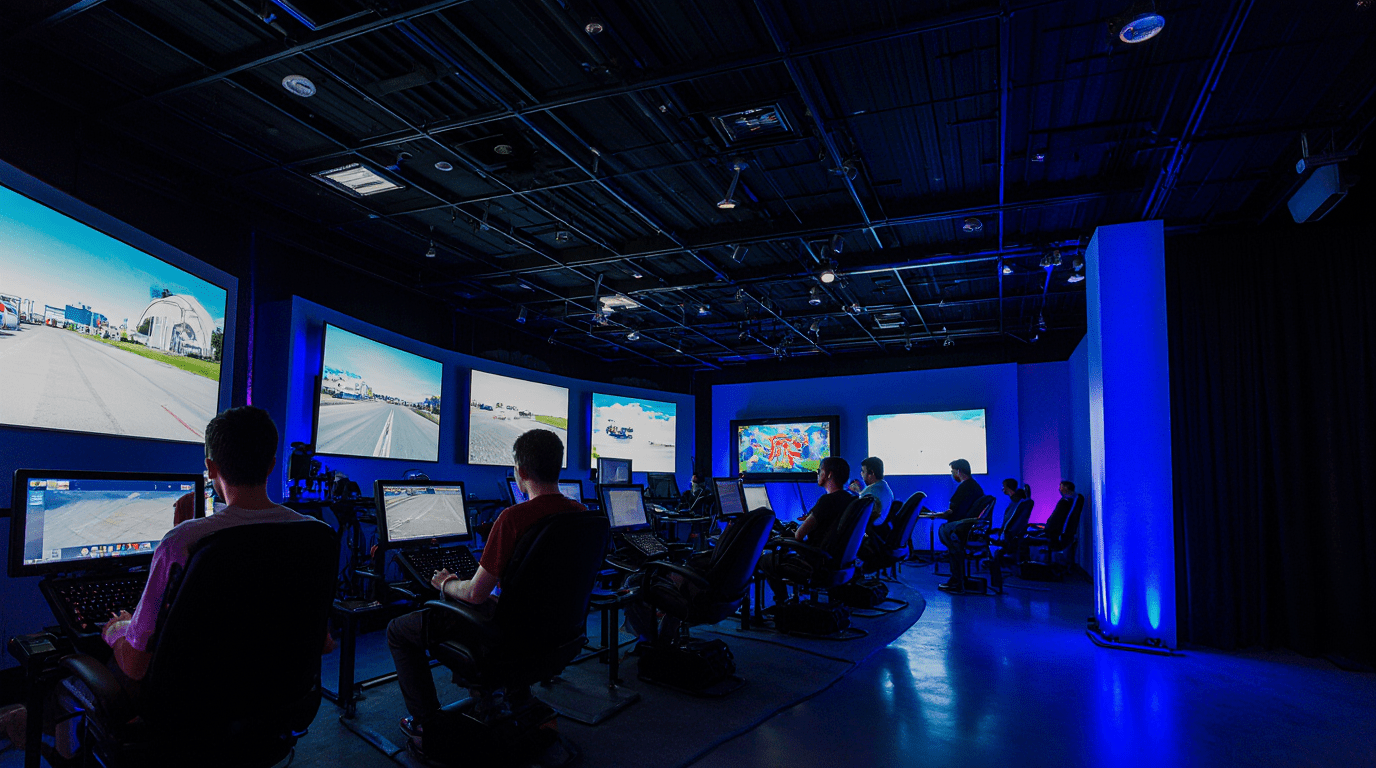
In recent years, centers have emerged that offer professional simulators for sessions, courses, or competitions. They function like "digital go-karts," but with a more technical focus.
Well-structured motorsports eSports teams
There are teams made up of real drivers, engineers, mechanics and young talents who compete at a national and international level.
This combination has made Spain a benchmark in virtual competitions, hybrid events and training activities.
How simulation centers work.
Simulation centers are usually based on a simple model:
- Professional equipment : high-quality rigs, advanced pedalboards, robust hardware.
- Flexible schedules : hourly training, internal leagues, in-person championships.
- Additional services : sessions with engineers, telemetry analysis, individual coaching.
- Corporate events : car brands, dealerships and workshops use them to attract an audience.
The user profiles are varied:
- Fans who want to experience driving without owning a race car.
- Karting or beginner drivers who use simulators to train technique.
- Curious drivers looking to improve reflexes and vision.
- Young people who see simulators as a more realistic access to the world of motorsports.
The boom is not only due to simulation as entertainment, but also because the simulator offers something that previously only existed in professional circuits and courses.
eSports teams: structure, training and professionalization
A serious sim racing team may seem small from the outside, but its structure is closer to that of a real racing team:
- Virtual pilots with weekly training sessions.
- Engineers in charge of setups, pressures, geometries and strategies.
- Telemetry analysts , responsible for comparing times and paths.
- Coaches , who work on psychology, consistency and rhythm.
- Marketing and network managers , needed to attract sponsors.
The level of professionalization is such that some virtual pilots have ended up competing in real categories after excelling in simulation tournaments.
The reverse flow: real pilots training in simulators
Many professional pilots use simulators regularly to:
- memorize circuits,
- work with braking references,
- practice difficult situations without risk,
- adjust reflexes and peripheral vision,
- maintain rhythm in preseason.
Some racing workshops and tuners have incorporated simulators internally so that their drivers can train without depending on the circuit.
Impact on young fans: a gateway to the sector
One of the most interesting effects of sim racing is its impact on teenagers and young adults. The simulator is a very serious entry point into driving techniques, basic vehicle engineering, and applied mechanics. Many learn:
- differences between front-wheel drive, rear-wheel drive and AWD,
- how suspensions work,
- What are oversteer and understeer?
- How does tire pressure influence handling?
- What does a self-locking differential do?
- How to read basic telemetry.
For a mechanic or a professional in the sector, this means a new generation of customers who are much more informed and curious, who value technical work and better understand the limits of a car.
Real impact on mechanic shops and car owners
Although sim racing seems like a parallel world, it is beginning to influence the real business:
New customers more interested in the car's actual performance
Many users who start driving after years of simulators look for cars with good chassis, better brakes, or quality tires.
Increased demand for technical advice
Simracing enthusiasts tend to ask more questions, compare more, and value explanations about geometries, alignments, and predictive maintenance.
Opportunities for workshops
Some workshops already organize:
- events with simulators to attract audiences,
- technical talks ,
- open days linked to brands or motor clubs.
A simulator in the workshop is not essential, but it is a tool that many businesses use to attract a community they didn't have before.
The emotional bond
A user who enjoys driving, even in a simulator, takes better care of their real car. And for a garage, that translates into better maintenance and longer-lasting relationships.
The business side: where is the money?
The business surrounding motor simulators and eSports in Spain is based on several pillars:
- Simulation centers with high occupancy .
- Teams and schools that sell technical training .
- Hardware sales (steering wheels, platforms, pedals, PCs).
- Corporate events and promotional activities .
- Automotive brands that use sim racing to connect with young people .
- Streaming and digital content , a source of income for top pilots.
- Sponsorships and hybrid competitions (circuit + simulator).
It's not a gigantic market, but it is a solid and expanding one, especially in cities with a strong automotive tradition.
Current challenges in the sector
It's not all about growth. There are three clear problems:
- High cost of professional hardware , which limits its domestic expansion.
- Initial saturation in some tournaments , where the level has risen a lot and it is difficult to stand out.
- Low media visibility compared to other more mainstream eSports.
Even so, its progress is gradual and sustained.

More than a video game, a real bridge with the engine
Sim racing isn't a replacement for real-world motorsport, but it is an accessible, technical, and exciting entry point. In Spain, simulation centers, esports teams, and virtual drivers are building a solid and respected ecosystem where fans, professionals, and future talents coexist.
Its impact isn't limited to the digital world: the young people competing in simulators today will be the car owners of tomorrow, and many will end up in workshops, racetracks, or within the automotive industry. That's why the automotive sector, including workshops and professionals, is learning to see sim racing not as a game, but as an opportunity to connect with a new generation that loves driving, even before they have a license.