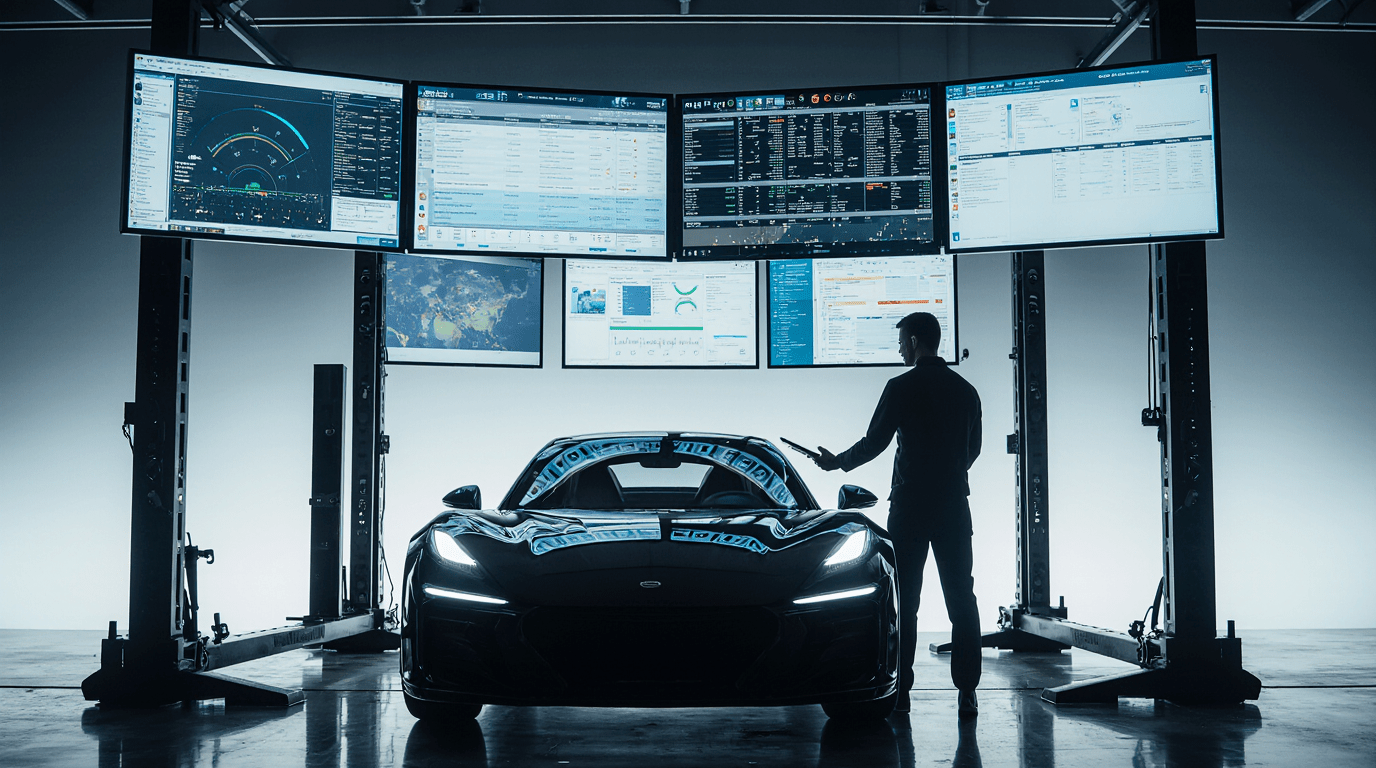
The software era is also invading the world of automotive parts and maintenance. It's not just about replacing parts, but about the car "talking" to you before something goes wrong. Thanks to artificial intelligence (AI), vehicles, sensors, and data are opening up new possibilities: detecting faults before they occur, adjusting parameters according to driving style, and making "tuning" more than just aesthetics. Let's see how this is being applied in Spain, what it offers, and what you should know if you work in the automotive parts or repair industry.
1. What does “AI in tuning and maintenance” mean?
When we talk about AI applied to automobiles, we're not just referring to autonomous cars (although that's included too). We're talking about systems that analyze vehicle data: connected sensors, on-board diagnostics, applications that measure the real-time condition of components, algorithms that predict faults, and adjust electronics to adapt to driving style.
For example, a system that "sees" a turbocharger has repeatedly operated at high temperatures and issues an alert before it fails; or an engine map that adjusts fuel injection based on driver behavior and anticipates optimization. According to Visure Solutions+1 , AI in the automotive industry enables "predictive maintenance" because it analyzes sensor data in real time to detect anomalies before they become problems.
In Spain, although the market is not as saturated as in pioneering countries, initial studies show that more and more workshops and manufacturers see AI as a lever for competitiveness.
2. Why is it being strengthened now and what does it offer for spare parts?
A. More sensors = more data
Modern cars are equipped with dozens of sensors: temperature, pressure, vibration, oil level, battery charge, and even driver behavior. This allows for the collection of real-time data to feed AI algorithms that detect "anomalous" patterns. A recent academic study demonstrates that integrating AI for predicting faults in combustion engine vehicles increased diagnostic accuracy compared to traditional methods.
B. Custom settings
Not everyone drives the same way. Intelligent digital tuning allows the car's software to adapt to driving style, vehicle load, and typical routes. This opens up a new area for replacement parts: components or adjustments that were previously standard can now be customized according to usage.
C. Proactive Maintenance
The old model was “breakdown → repair”. With AI, it becomes “detection → preventative action → improved lifespan”. This reduces costs, minimizes premature replacements, and creates opportunities for shops and workshops to offer “proactive” services.
3. Specific applications in Spain
- At the Basque Automotive Manufacturing Center (BAM) in Vitoria, a public-private project uses sensors and AI for the early detection of defects in bodywork, parts, and components. This is currently only in manufacturing, but the logic can be applied to the spare parts and maintenance sectors.
- A report by Posventa.info indicates that 87% of Spaniards trust that AI functions can guarantee their safety behind the wheel. This suggests that the market is ready to accept AI applications in vehicle maintenance and tuning.
- Beyond the car, the integration of connected systems allows onboard applications to collect usage data, predict breakdowns, and offer remote maintenance services.
Although exact figures on how many reprogrammings or "digital tuning" with AI are carried out in Spain are not always published, the technological foundations are present and the demand is growing.
4. What does this mean for the world of spare parts and workshops?
▪ Smart stock and parts
It's not enough to have brake pads or air filters; "smart" or connected parts are also needed: condition sensors, adaptive control modules, and systems that feed data to diagnostic software. Auto parts stores should consider:
- “OEM+” sensors compatible with diagnostics
- Reprogramming modules adapted to driving styles
- Connected maintenance kits (e.g., hybrid/electric battery monitoring kits)
▪ Value-added services
- Advanced diagnostics + AI: workshops that offer "car health" through data analysis.
- Digital customization: adjusting parameters via software according to the actual use of the car.
- AI-powered warranties and tracking of installed parts: "I'll notify you when a part enters a risk zone."
▪ Training and equipment
Technology demands that mechanics adapt: reprogramming interfaces, big data analysis, AI alert interpretation, calibration protocols. Those who fail to keep up risk losing their competitive edge.
5. Opportunities and risks for drivers
Opportunities
- Fewer breakdowns: if the system detects that a part is going to fail, action can be taken beforehand.
- Better adaptation to real use: if you use the city a lot, load cargo, tow a trailer, the car "learns" and adapts.
- Higher resale value: a smart maintenance history can increase the value of the car.
Risks
- Cost: These services may have an extra cost or require premium parts.
- Homologation: electronic modifications or software adjustments must be within the law, to avoid losing warranty or insurance.
- Privacy/data: connected cars collect a lot of data—who manages it?
- Unrealistic expectations: not all adjustments lead to drastic improvements if the vehicle is poorly maintained or the mechanical base is deficient.
6. How to get started if you're interested
- Question: Does the workshop offer intelligent vehicle data analysis using sensors? Does it issue a health report?
- Ensure compatibility: the vehicle must have the appropriate sensors and electronics to connect.
- Check make/model: some models have more room for improvement, others are highly optimized from the factory.
- Check warranty and insurance: make sure the modifications do not invalidate the coverage.
- Basic equipment: a good OBD scanner, parts condition sensors, reprogramming interface + diagnostic software.

Artificial intelligence is transforming automotive tuning: it's no longer just about aesthetics or power, but also about performance, anticipation, and personalization. For those who work in parts or maintenance, it represents a great opportunity. For drivers, it's a new way to care for their vehicle and adapt it to their lifestyle. But as always, the human factor remains key: choosing wisely, understanding what you're doing, and with whom you're doing it. With AI at the helm of maintenance, the car no longer waits to break down: it warns you beforehand.